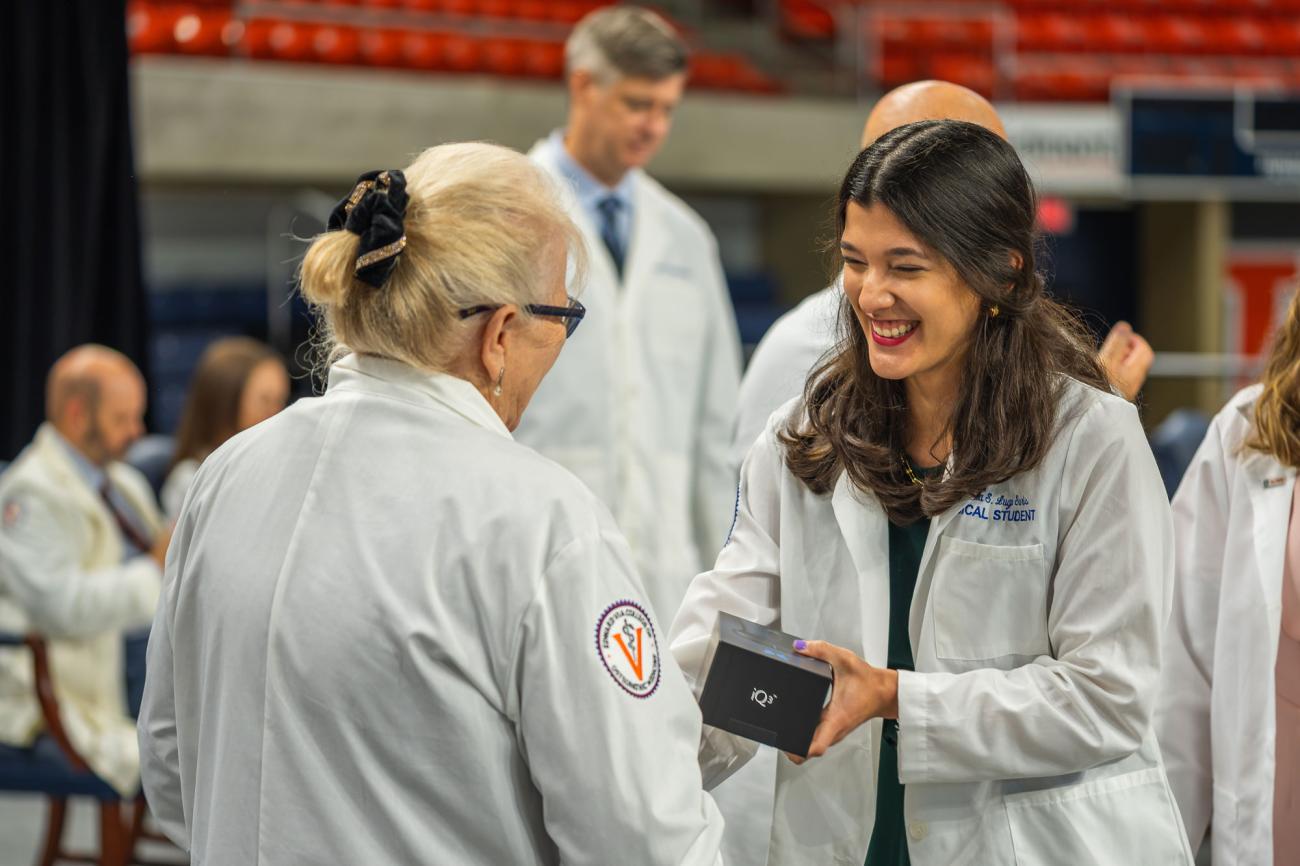
Every student at the Edward Via College of Osteopathic Medicine (VCOM) will receive a personal handheld point-of-care ultrasound (POCUS) device beginning this academic year. The devices are being provided through VCOM’s ongoing partnership with Butterfly Network, a medical technology company specializing in handheld ultrasound.
While ultrasound education is becoming more common in medical schools, relatively few provide every student with a personal device. Students in all four class years will receive the devices, starting with first-year students, who received theirs at VCOM’s recent White Coat ceremonies. Going forward, each incoming class will receive devices at the beginning of medical school for use throughout their four years at VCOM.
Students already use ultrasound technology in anatomy laboratories, using the devices on their peers to visualize normal anatomical structures and connect living anatomy with what they learn in the lab and classroom. This year, VCOM expanded the use of POCUS in clinical procedural skills training.
Giving every student their own device allows us to make ultrasound a consistent part of their education from the very beginning. Students can use it to strengthen their understanding of anatomy, build their physical examination and clinical reasoning skills, and become comfortable with a technology they are increasingly likely to use in practice. By the time they graduate, we want POCUS to feel like a natural part of the way they evaluate and care for patients.
POCUS fits naturally into osteopathic education. Osteopathic medicine emphasizes the relationship between structure and function, hands-on patient assessment, and whole-person care. Point-of-care ultrasound complements these principles by allowing physicians to integrate imaging directly into the physical examination and evaluate patients in real time.
Experience with POCUS will carry into residency and clinical practice, where physicians can use POCUS to support clinical decision-making and guide procedures at the point of care. VCOM students will enter residency with extensive experience using the technology.
POCUS may be especially valuable for VCOM graduates who go on to practice in rural and medically underserved communities, where access to advanced imaging services can be limited or delayed. Because POCUS is portable, physicians can use it to evaluate patients without relying solely on access to larger imaging systems.
VCOM’s partnership with Butterfly will continue beyond students’ medical education, with opportunities for continued training, research, global health, and support for physicians practicing in rural communities. Through Butterfly Network’s Lighthouse Program, participating VCOM graduates will be able to share information about how they use POCUS in practice, helping improve future training and technology while building a better understanding of how POCUS is used in different clinical settings.